


Journal
The Rolex ‘Oman’ Sea-Dwellers
The Rolex ‘Khanjar’ & ‘Qaboos’ Sea-Dweller
Muscat & Oman
The state of Oman lies on the Southeast tip of the Arabian Peninsula, a position of extreme strategic importance with regard to the flow of oil through the Gulf. It has long standing military and political ties with the United Kingdom and United States.
Ruled by the Al Bu Sa’idi dynasty since 1744. Oman was once a regional power, with a sultanate that extended to Iran, modern day Pakistan and south to Zanzibar on the coast of southeast Africa. Over time, its power declined and it came under the increasing influence of the United Kingdom.
From 1932 to 1970 Oman was ruled by Sultan Sai’d bin Taimur.
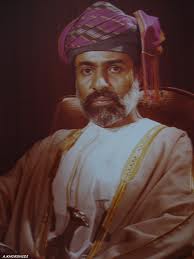
Sultan Sa’id whilst careful to maintain Oman’s relationship with the United Kingdom took little interest in maintaining the ongoing stability of his country. Restricting Oman’s contact with the rest of the world, discouraging development and unable to handle the increasing complexity of domestic politics, Omani affairs became an international concern.
By 1962, Marxist revolutionaries formed the Popular Front for the Liberation of Oman in the province of Dhofar and revolted against the Sultan. Sultan Sa’id survived an assassination attempt but the events had a profound effect, he became more withdrawn and erratic in his governance. No one was safe from the Sultan’s control and increasing paranoia, including his son Qaboos Bin Sa‘id.
Sultan Qaboos & the Coup d’état
Sultan Qaboos Bin Sa‘id (pictured below) was born in Salalah in Dhofar on 18 November 1940. In 1960, at 20 years of age, he entered the Royal Military Academy Sandhurst in England, forming a great friendship with Tim Landon who would become a significant ally in the development of Oman in future years. After graduating from Sandhurst, Qaboos joined the British Army and was posted to the 1st Battalion The Cameroonians (Scottish Rifles), serving in Germany.
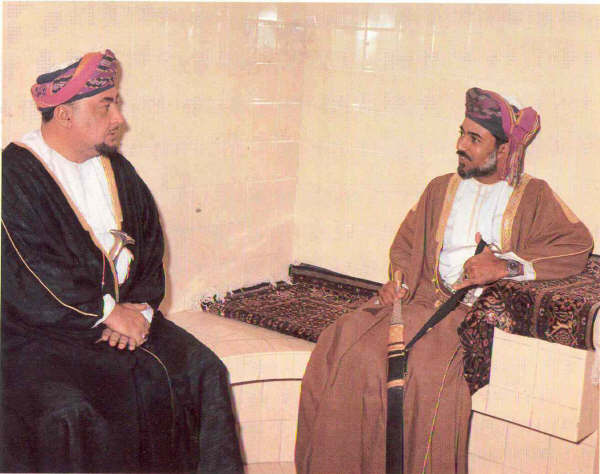
On his return to Oman in 1964 Qaboos was placed under house arrest by his father Sultan Sa’id, and remained there until July 23, 1970, when with the support of the British government (who had become increasingly concerned by Sultan Sa’id’s behavior and with Oman on the brink of an oil boom, the British were keen to share) agreed to deploy operatives from the SAS to enable Qaboos with the assistance of his friend Tim Landon to depose his father Sultan Sa’id in a palace coup d’état.
Brigadier Tim Landon, the mysterious ‘White Sultan’ as he became known, is believed to be a key ally in the plot to overthrow the old Sultan and put his son on the throne. A latter-day T E Lawrence, Landon served Britain well through a close bond with the Arab world. He remained a close friend and advisor to Qaboos through-out his life.
The above image is believed to be the only one in existence of Landon, a man who guarded his privacy very closely. It is said that when at home in the UK he would drive a privately owned black London taxi to avoid attention. It is also rumoured that Qaboos would send Landon a gift of £1m GBP each year on his birthday, and on his death in 2007 his wealth was reported to have exceeded that of the Queen.
Following the coup, the deposed Sultan Sa’id bin Taimur went into exile in London and died 2 years later. When asked once of his greatest regret, the Sultan replied: “Not having had Landon shot.”
The New Oman & the SAS
On his ascension to the throne in 1970, Qaboos immediately instigated major social, educational and military reforms, with the intention of ending the country’s isolation and using its oil revenue for modernization and development.
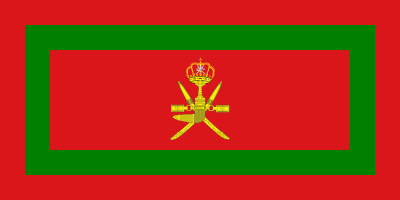
In a further re-branding exercise, he declared that the country would no longer be known as ‘Muscat and Oman’, but would change its name to “the Sultanate of Oman” in order to reflect its political unity, This was complimented by a new flag which replaced the traditional white flag that had been used since 1865. The National flag of Oman circa 1970-1995 featured the 3 colours of Red, White and Green.
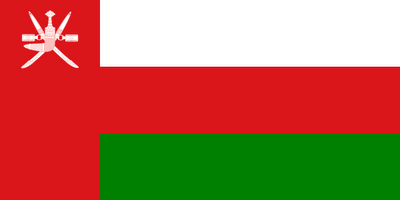
The colours of the new flag symbolized the following:-
White = Peace and prosperity
Green = Fertility and the Jebel al Akhdar or Green Mountains
Red = Battles against foreign invaders
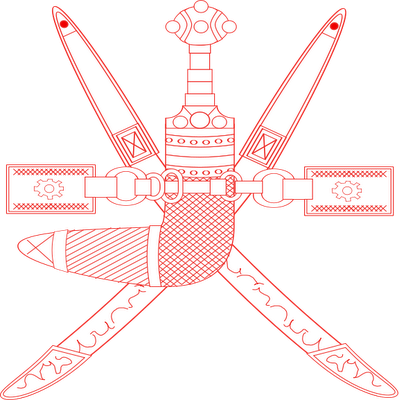
and incorporated the national emblem, a Khanjar dagger (pictured below) in a sheath superimposed upon two crossed swords.
Qaboos also added a new individual standard for the Sultanate of Oman, which exclusively featured the Khanjar in Gold with Sultans Crown above.
>In addition to implementing the necessary reforms to safeguard Oman’s future, Qaboos faced another issue, the Dhofar Rebellion that had commenced in 1962 was by 1970 growing ever stronger.
The British Military commanders in Oman suggested that a “hearts and minds” campaign code named ‘Operation Storm” be put into operation primarily by operatives from the British Special Forces elite 22nd SAS regiment (Boat, Air, Mobility & Mountain counter terrorism specialists).
Once ‘Operation Storm” was underway, many of the Omani’s who opposed the Dhofar rebels (because of differing beliefs) sided with the SAS who formed them into ‘counter gangs’, using their superior local knowledge, a strategy that had worked well for the SAS in both Kenya and Malaya. The SAS gradually began to occupy commanding positions on the mountain range throughout the Dhofar region, incurring running battles with the Dhofar rebels as they did.
9 SAS vs. 250 Dhofar Rebels
>“It was not our numbers, but our ideas”
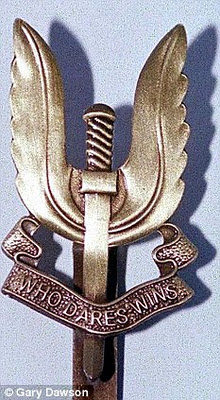
The Battle of Mirbat took place at 6 am on 19 July 1972. It has become one of the most famous standoffs in the regiment’s history; many have compared it to the famous battle at Rourke’s Drift.
A 9 man permanent SAS team had been established at Mirbat earlier in the year. Each team was due to be posted for a three-month tour before being replaced. The occupying team was preparing to leave that very morning, when at about 5:30am a patrol discovered the 250 rebels on a hill to the North of the town.
One of the SAS gunners recalled what happened.
“We opened fire simultaneously, unleashing a hail of .50 cal bullets and machine gun fire at the approaching Adoo rebels. The running figures became a focal point where the red tracer and exploding incendiary rounds converged. Where moments before there had been an orderly advance, parts of the line now faltered and collapsed. Figures staggered, but still they kept coming, wave upon wave over the plain.”
The surrounded SAS troops knew the situation the situation was serious, a frontal assault could only mean they were facing a very large force, a message was sent to the SAS HQ at Salalah. The rebels were well organised, advancing in groups and using high ground to lay down covering fire, by now rounds were coming in from all directions over the forts.
A lull in the fighting as the rebels recovered their wounded allowed two SAS troops to reach the gun pit of an antique 25 pounder (pictured below), which was used to devastating effect on the rebels, but as they fell more replaced them.
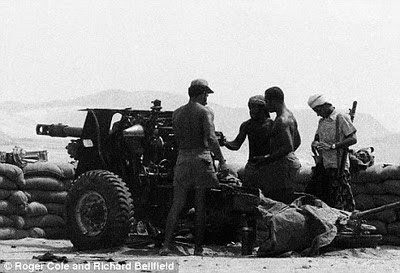
The perimeter walls started to collapse under heavy grenade attacks. A helicopter sent by HQ attempted to land on the nearby beach to evacuate the wounded but was hit by enemy machine gun fire and forced to turn back. At the gun pit one of the SAS troops had been killed and the other one bad wound to his chin resorted to firing the gun single handed, with the cannon raised to fire level at point blank range.
The 23 year old SAS captain Mike Kealy radioed for an air-strike, by now the rebels were almost on top of the gun pit, the remaining men continued to pick off the advancing troops despite an almost continuous hail of bullets and grenades. Just as all seemed lost two Strike master jets roared over.
From the radio the jets were given targets, they would have to drop 500lb bombs on positions less than 60 yards from the gun crew. Just the sight of the jets had an immediate effect on the rebels, many began retreating. One jet was hit by heavy machine gun fire and forced to withdraw, more aircraft were called in while the rebels continued to retreat. A squadron based at SAS HQ were also dispatched and landed on the beach after flying in very low to avoid detection. A second air strike began as they were landing.
By 10.30am the rebels were forced to retreat in numbers, the wounded were loaded on to the helicopters and flown back to HQ.
SAS casualties included two dead and two seriously wounded.
In Britain the battle received no publicity, the gallantry awards not awarded until some four years after the event. The 9 SAS soldiers present at the battle of Mirbat on 19 July 1972 were
▪ Captain Mike Kealy
▪ Staff Sergeant Talaiasi Labalaba (Killed in Action) (pictured below)
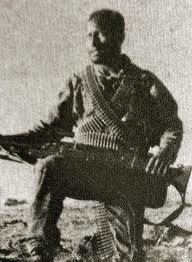
▪ Sergeant Bob Bennett
▪ Corporal Roger Cole
▪ Lance Corporal P. Warne (aka Pete Wignall or Winner, Soldier I & Snapper)
▪ Trooper Sekonaia Takavesi (Killed in Action)
▪ Trooper Tommy Tobin
▪ Austin “Fuzz” Hussey
▪ Corporal L. M. Taylor (Understood to have been an alias)
Mission Accomplished
When the Dhofar rebellion finally ended in 1976 with the insurgents suppressed, the SAS contingent that had been engaged in the conflict from the time of the coup amounted to around 80 men (supported by Oman locals). The insurgents had numbered almost 15,000, a staggering achievement.
The 22nd SAS Regiment went on to engage in countless other anti terrorist campaigns, and achieved notoriety during the 1982 Iranian Embassy siege which was broadcast worldwide.
Recognition by Gifts
There is a custom in the Gulf of presenting gifts, often watches, in recognition of achievements, appreciation or as a mark of respect. British troops on active duty would not normally be allowed to accept such gifts. However in the case of Oman circa 1970-76 the restrictions did not apply. The SAS were never officially on active duty, but in Oman under the cover of the ‘British Army Training Team’ as the official documentation of the time advised.
Two example which we have previously owned and subsequently placed in important collections, provide the perfect opportunity to study further both the Rolex 1665 Red & Gold Khanjar Sea-Dwellers which were presented as gifts to SAS operatives by Qaboos for the 1970-76 Oman campaign.
The Rolex RED ‘Oman Khanjar & Qaboos’ Sea-Dwellers
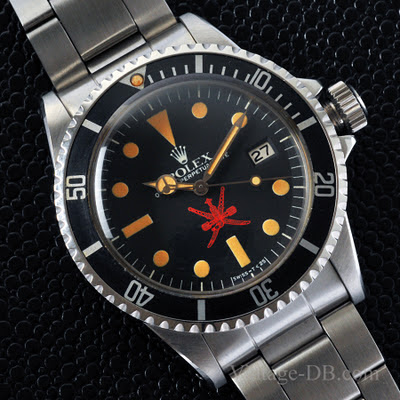
The Rolex modelref. 1665 Oman Sea-Dwellers with either RED Khanjar or Qaboos dial script, were commissioned by Sultan Qaboos bin Sa’id via ASPREY of London in the early 1970s and presented to the British Military SAS troops who had served in Oman during the Dhofar rebellion between 1970-1976.
Many of the watches that have surfaced, like the one above, are found with a deep patina, due to the humidity in the Middle East being absorbed by the heavy tritium markers.
The configuration of the watches that have surfaced to date is as follows: –
• The Double Red lines, Depth rating and SCOC found on the standard 1665s of the period are absent and in its place the Omani Khanjar or Qaboos signature in bright red script.
• The tritium application on the 5 minute markers is very heavily applied.
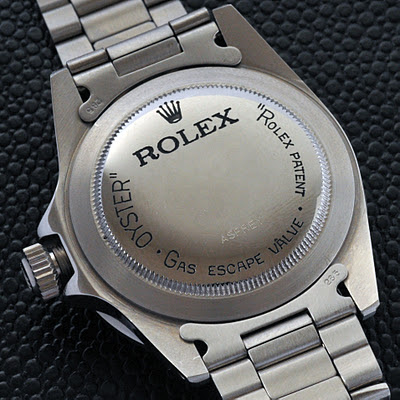
• The serial numbers all begin 3,56x,xxx and are engraved between the lugs at 06:00 and inside the inner case back.
• The outer case back has the expected straight ‘Rolex’ style engravings of the period, but also carries the ASPREY engravings in the lower centre.
Following a comprehensive study of the known serial numbers, I believe that upto 90 examples were produced in a consecutively numbered batch starting with serial 3566,9xx and ending at 3567,0xx. Of these estimated 90 examples, approximately 30% are now known. The known watches are evenly represented by either Red Khanjar or Qaboos dials, and the 2 dial variants have been fitted in a random sequence, i.e. we see consecutive serials with either dial, and then small batches of 3-4 watches with one dial type or the other.
The approximate number of watches issued is further supported by the number of SAS soldiers who served in Oman during the period 1970-1976 again reported to be around 80-90 operatives, so the assumption is that each soldier would have been allocated a RED Oman Sea-Dweller in recognition of their services.
The use of the colour Red for the Khanjar or Qaboos signature on the dials is also relevant to the colour of the new Oman national flag during this period. Red symbolized battles against foreign invaders. How very appropriate.
The Rolex GOLD ‘Oman Khanjar’ Sea-Dweller
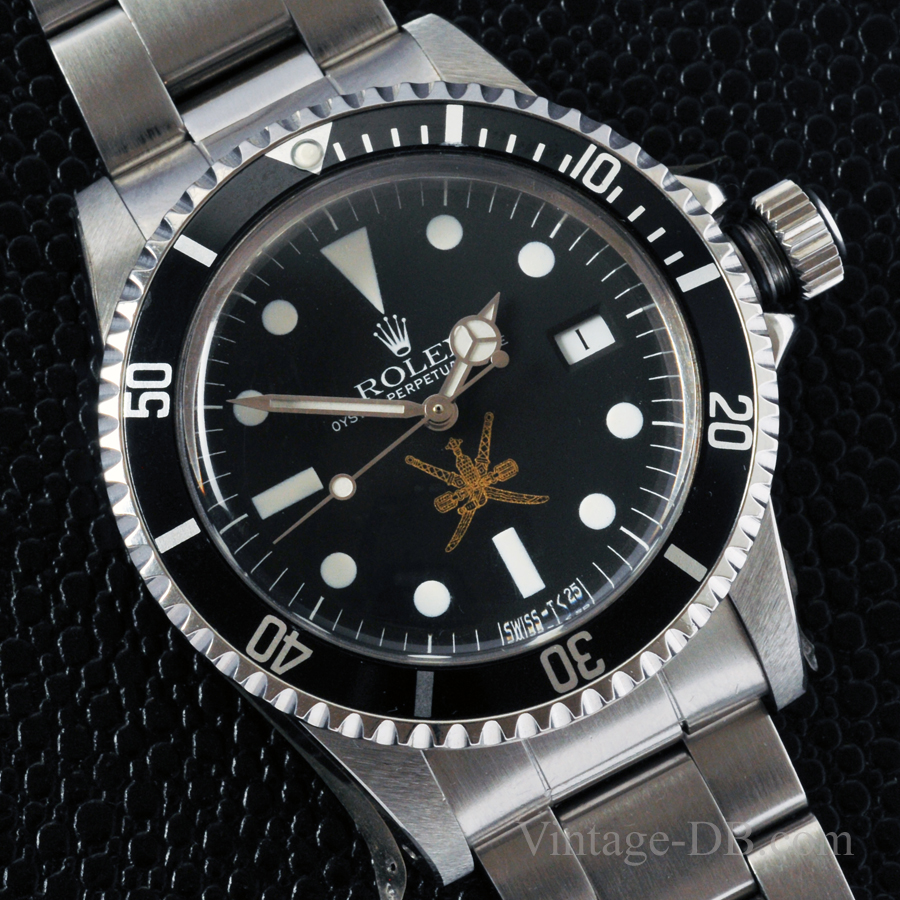
To date only 5 examples of the Rolex 1665 Omani Sea-Dweller with GOLD Khanjar dial script have surfaced and as such the information on configuration and delivery was something of mystery when compared to its Red counterparts. The watch featured above is the 4th example to have surfaced, with each new discovery aiding our understanding of the batch.
The configuration of the Rolex 1665 Omani Sea-Dwellers with GOLD Khanjar dials that have surfaced to date is as follows:-
• The 2 lines of Double Red Text, Depth rating and SCOC found on the standard 1665s of the period are absent and in place the Omani Khanjar in Gold script.
• The Rolex coronet on the dial is a unique style and different to the Rolex 1665 Oman Red Khanjar or other coronets on the Double Reds of the period.
• The tritium application on the 5 minute markers is absent or minimally applied.
• The serial numbers all begin 5,xxx,xxx
On further analysis of the known watches the serials indicate something more. On 4 of the 5 known watches including our recent acquisition (pictured above) the serials are within the standard Double Red batch of 5,0xx,xxx
I have deliberately omitted the serial numbers, but they indicate a clear timeline.
On these 4 watches the serial number is also engraved between the lugs at 6:00 and inside the case back.
2 of the above 5 watches have been serviced within recent years by Rolex Geneva and records appear correct.
The other known example has a slight variation to the serial, and while close, is slightly later at 5.3xx,xxx. The case back style also differs although consistent with the Great White Sea-Dwellers of this period. The inner case back does not have the serial number engraved inside, which whilst again consistent with a 5,3xx,xxx serial Sea-Dweller, would also indicate that the dial was quite probably not born with the watch but fitted later, as it appears out of batch. However, until more examples surface or the delivery is confirmed by Rolex, it remains only a thought.
So how many were of the Rolex 1665 Omani Sea-Dwellers with GOLD Khanjar dials were produced, and why?
If we assume the same ratio as with the Red Oman watches, i.e. approximately 90 watches produced with 30% of them having surfaced to date, this would indicate a production of Gold Khanjar Sea-Dwellers upto around 15 watches.
Using the historical information provided earlier of Oman during the period 1970-1976, we know that the Gold Khanjar was used only to represent the Sultanate of Oman on the Sultanates official standard, whereas the national flag features the Khanjar in White. If the use of Red on the Red Khanjar / Qaboos Sea-Dwellers is as we believe significant, it would suggest the use of Gold here would also be, possibly to indicate a special presentation directly by Sultan Qaboos himself.
We know that the battle of Mirbat was under-reported and many considered the SAS team deserving of further individual awards for gallantry. However, many in Oman at that time perceived a desire by HM Government and the MoD to downplay incidents of direct involvement of British service personnel in military action. The British Military Intelligence Corporal who received a medal for gallantry from the Sultan at the time was threatened with disciplinary action by the British Army for being directly involved.
So it was not until some 4 years later, after the battle and once the Dhofar rebellion had been suppressed that: –
· Captain Mike Kealy received the Distinguished Service Order.
· Sergeant Bob Bennett was awarded the Military Medal.
The gunners on the 25 pounder
· Trooper Sekonaia Takavesi received the Distinguished Conduct Medal and
· Staff Sergeant Talaiasi Labalaba was awarded a posthumous Mention in Dispatches.
His former comrades have since campaigned for him to be awarded a posthumous Victoria cross.
We know that Qaboos was fully aware of the Battle of Mirbat as he presented an Omani named Walid Khamis, who was injured during the battle, with the Sultan’s Gallantry Medal, Oman’s highest award.
Given that the Battle of Mirbat was pivotal moment in defeating the insurgents, and the lack of recognition given to the SAS soldiers by their own government, it is not inconceivable to think that Qaboos who had previously commissioned the Red Oman watches to commemorate the SAS soldiers who occupied Oman during the 1970-1976 campaign would commission a small special batch to honour the 9 SAS (and possibly others like William Stoker SOAF Strike master Jet commander) who put their lives at risk during the Battle of Mirbat to defend Oman from the rebellion.
Of course without official delivery information from Rolex, Qaboos or the surviving SAS soldiers, we cannot be at all certain, but the theory should encourage further discussion, research and understanding of the events in Oman during the 1970s and the important watches that commemorate the period.
Thank you to Dr. Stephen B, Steven E, Paolo & Marc S for their invaluable contributions.
© Copyright Daniel Bourn www.danielbourn.com
If you are an original owner of a vintage Oman issued Rolex Khanjar or Qaboos watch & wish to SELL, value or share your story, please contact Daniel Bourn on +33 6 78 63 37 59 or via email monaco@danielbourn.com.