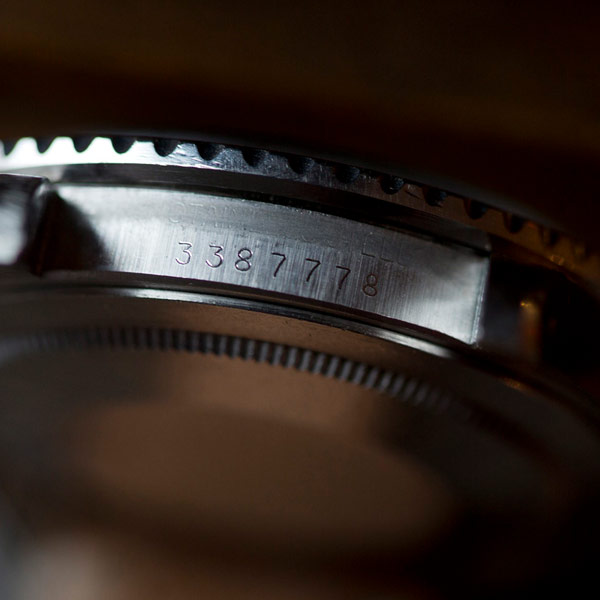
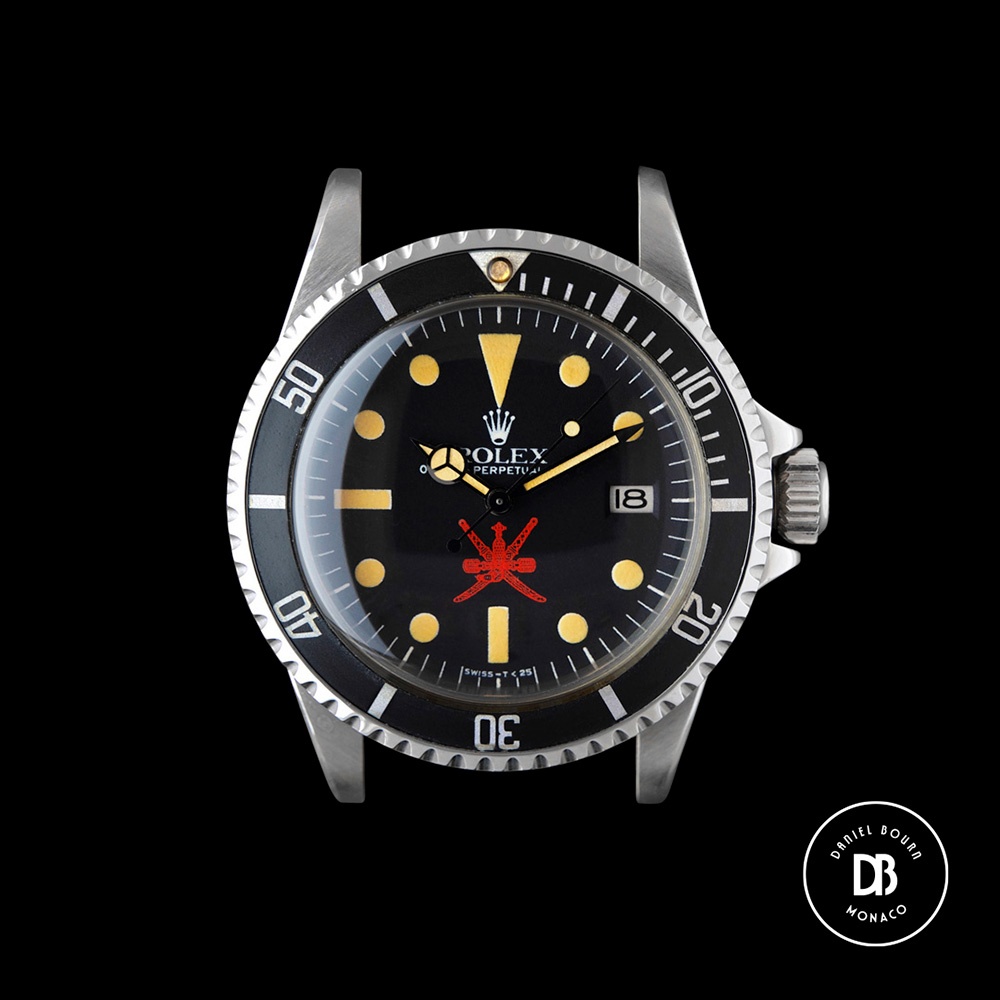
The Geneva Watch Sales: Fall 25 Review

Image: Phillips Watches

Post-Auction Review

The Geneva segment of the Fall 2025 auction season built on Monaco Legend Group’s impressive opening in late October, reconfirming interest, new investment, and growing demand for rare, historically significant timepieces in exceptional original condition.

A total of 1,233 lots were offered across the four major houses, generating a record-breaking USD 145.4 million, with a combined sell-through rate of 96 percent.

Phillips set the benchmark, selling 100 percent of all offered lots, with unprecedented total sales of USD 83 million. This marks the highest amount ever achieved in USD for a single watch auction. Phillips reported that the two-day sale attracted 1,886 registered bidders from 72 countries, with more than 800 attendees in the saleroom.

Antiquorum’s 691 lots realised USD 8.8 million, with a 90 percent sale rate, evidence of market interest at all price points.

The combination of a live auction, thematic Breguet sale, and concurrent online catalogue (not included in this report), orchestrated by a new generation of auctioneers, Benoit Colson and Clara Kessi, brought renewed energy and professionalism to the rostrum, enabled Sotheby’s to achieve its best Fall-season results in over a decade.

Christie’s Rare Watches concluded the extended Geneva weekend with total sales of USD 26.6 million, 21 percent of entries exceeding their high estimates. Notably, 37 percent of buyers were new to the watch category, and registrants from 47 countries highlighted the international strength of the watch market.

This auction weekend was unquestionably one of the most highly attended in recent times, with a record number of collectors, dealers, and observers present from around the world.

Image: Christie’s Watches

The Watch Auction Calendar – Fall 2025

Date Auction House Location Sale Title
October 18–19 Monaco Legend Group Monaco Exclusive Timepieces
November 8–9 Phillips Geneva Decade One (2015–2025)
November 8–9 Antiquorum Geneva Important Timepieces
November 9 Sotheby’s Geneva Important Watches: Part I
November 10 Christie’s Geneva Rare Watches
November 21 Phillips Hong Kong The Hong Kong Watch Auction: XXI
November 26–27 Christie’s Hong Kong Important Watches
November 30 Antiquorum Hong Kong Important Timepieces
December 5 Sotheby’s Abu Dhabi Prestigious Jewels & Watches
December 6–7 Phillips New York The New York Watch Auction: XIII
December 8 Sotheby’s New York Important Watches
December 9 Christie’s New York Important Watches
December 13 Antiquorum Monaco Important Timepieces

Image: Sotheby’s Watches

Pre-Auction Selection Results
Our pre-auction review selection highlights performed as follows:

Phillips in Association with Bacs & Russo – Geneva, November 8–9, 2025
Lot 23 – A Patek Philippe ref. 1518 in stainless steel
Estimate: USD 8.75 million
Despite some negative commentary from market observers prior to the sale Phillips, the star lot achieved an impressive USD 17,549,691, reaffirming its position as one of the most important wristwatches ever offered at auction, and significantly improving on its last appearance at auction in 2016 when it sold for approximately USD 11.4 million.

Antiquorum – Geneva, November 8–9, 2025
Lot 501 – A Patek Philippe Ref. 3796 Calatrava in platinum
Estimate: USD 12,500 – 18,800
Among the pieces highlighted in our pre-auction report was Lot 501, a Patek Philippe ref. 3796 in Platinum with box and papers, which sold for USD 26,598, reflecting the ongoing demand for original, well-preserved, neo-vintage box sets.

Sotheby’s – Geneva, November 9, 2025
Lot 134 – An early pre-production Rolex Oyster ref. 34075 in 9ct gold
Estimate: Upon Request
The historically interesting prototype formerly owned by Mercedes Gleitze, the first British woman to swim the English Channel realised USD 1,724,131.

Christie’s – Geneva, November 10, 2025
Lot 26 to 29 – 4 x Patek Philippe ref. 3970 with rare Breguet dials
Estimate: USD 1.5 – 1.95 million (total)
The factory-sealed group of four watches manufactured exclusively for the opening of the Geneva Salon in 2006 achieved a staggering combined total of USD 4,386,848, further highlighting current collector focus on rare variants of this model reference.

Image: Phillips Watches, Antiquorum, Sotheby’s Watches, Christie’s Watches

Key Metrics from the Geneva Sales

Auction House Sales Breakdown – Consolidated View

Auction House (by sale date) Total Sales (USD) # of Lots Sell-Through Avg. Lot Value (USD)
Phillips 83,018,538 209 100% 397,217
Antiquorum 8,812,723 691 90% 12,753
Sotheby’s* 11,894,578 84 96% 141,602
Sotheby’s** 15,156,076 70 94% 229,637
Christie’s 26,558,298 179 98% 148,370
Totals 145,440,213 1,233 96% 185,915

Focus by Brand – Consolidated View

Brand (alphabetical) # of Lots # of Lots Sold Sell-Through
Audemars Piguet 57 52 91%
Cartier 46 41 89%
Patek Philippe 220 210 95%
Rolex 231 218 94%
Independents*** 40 40 100%

Top Performing Lots by Brand

Brand (alphabetical) Auction House Lot # Description Price (USD)
Audemars Piguet Christie’s 103 Royal Oak QP ref. 25687PT 791,233
Cartier Phillips 134 Paris Model A clock 866,650
Patek Philippe Phillips 23 1518 “No. 1” in steel 17,549,691
Rolex Sotheby’s 134  Early Oyster “Mercedes Gleitze” 1,724,131
Independents Phillips 182 Chronomètre à Résonance 4,120,822


Image: Phillips Watches

Individual Sales in Excess of USD 1,000,000 (23 in total)

Brand Auction House Lot # Description Price (USD)
Patek Philippe Phillips 18 3424/1 “Gilbert Albert” 1,006,734
Patek Philippe Christie’s 89 5711 Nautilus “Tiffany & Co.” 1,022,464
Richard Mille Christie’s 146 Unique RM 018 1,022,464
Breguet Sotheby’s 66 No. 1052 Montre à Tact 1,038,195
Christian Klings Phillips 94 Tourbillon 7 1,101,115
Patek Philippe Phillips 80 2438/1 “Luminous Dial” 1,101,115
Patek Philippe Phillips 199 2497 “Secondi al Centro” 1,195,497
Rolex Phillips 34 6239 Daytona “Golden Pagoda” 1,337,069
Rolex Phillips 32 18059 Day-Date “Rainbow” 1,337,069
Ferdinand Berthoud Phillips 6 Naissance d’Une Montre 3 1,573,022
Patek Philippe Phillips 105 2499/100 “Gübelin” 1,647,957
Rolex Sotheby’s 134 Early Oyster “Mercedes Gleitze” 1,724,131
Rolex Phillips 70 6263 Daytona “RCO” 1,728,864
Patek Philippe Christie’s 29 3970 “Salmon Breguet” 1,732,710
Patek Philippe Phillips 213 2499 “First Series” 2,022,634
F.P. Journe Phillips 97 Tourbillon Souverain 2,097,569
Breguet / Daniels Sotheby’s 59 No. 3225 2,328,568
Breguet Sotheby’s 9 No. 1890 Tourbillon 2,328,568
Patek Philippe Sotheby’s 160 2499 “First Series” 2,404,123
J. Player & Sons Phillips 39 Hyper Complication 2,771,987
F.P. Journe Phillips 182 Chronomètre à Résonance 4,120,822
Patek Philippe Phillips 144 1518 “Pink on Pink” 4,420,563
Patek Philippe Phillips 23 1518 “No. 1” in steel 17,549,691


Image: Sotheby’s Watches

Market Pulse

The Fall auction season has, to date, defied geopolitical and economic concerns, signaling resilience, confidence, and new investment in the watch market.

Historic results at Phillips were complemented by notable trends elsewhere, included fewer pre-owned modern watches on offer, continued momentum for neo-vintage Patek Philippe, and exceptionally strong demand for top-tier vintage Rolex.

Independent watchmakers, though reduced in numbers this season, continued to attract sustained interest. F.P. Journe’s Chronomètre à Résonance “Souscription No. 2” achieved USD 4.1 million at Phillips, while a number of other small-production independents obtained notable results.

Buying activity was evident both inside and outside the auction rooms, with reports of extensive private transactions closed in addition to the published auction lots.

The upper tier of the market remains robust, with sold lots exceeding USD 1 million abundant throughout the weekend. With successful sales in Monaco and Geneva now concluded, the outlook for Hong Kong and New York auctions remains positive.

* Excludes the Breguet thematic sale at Sotheby’s.

** The Breguet thematic sale at Sotheby’s

*** De Bethune, Laurent Ferrier, Vianney Halter, F.P. Journe, A Lange, MB&F, Richard Mille, Voutilainen and Urwerk.

nb All amounts in USD converted from CHF using XE – November 2025.

Receive the latest watch content – straight to your inbox. SUBSCRIBE here

The Geneva Watch Sales: Fall 25

Pre-Season Overview

The fall auction season for rare, important, and luxury timepieces began at the end of October with the Monaco Legend Group Exclusive Timepieces event in Monaco. Achieving total sales of $33.3 million and a 97% sell-through rate, it marked the house’s strongest performance to date. Headline results included a Rolex reference 6062 with black dial and diamond indexes that sold for $6.2 million and a Patek Philippe reference 2481 with a cloisonné enamel dial that reached $1.1 million.

The season now moves to Geneva in early November, where a total of 1,163 lots will be offered by the four major auction houses, followed by sales in Hong Kong and New York, as well as a single-owner collector’s sale in Abu Dhabi in early December. Buoyed by strong early results and heightened anticipation for Geneva, this fall’s calendar is set to draw significant interest from collectors and market observers around the world.

Image: Monaco Legend Group

The Watch Auction Calendar – Fall 2025

Date Auction House Location Sale Title
October 18–19 Monaco Legend Group Monaco Exclusive Timepieces
November 8–9 Phillips Geneva Decade One (2015–2025)
November 8–9 Antiquorum Geneva Important Timepieces
November 9 Sotheby’s Geneva Important Watches: Part I
November 10 Christie’s Geneva Rare Watches
November 21 Phillips Hong Kong The Hong Kong Watch Auction: XXI
November 26–27 Christie’s Hong Kong Important Watches
November 30 Antiquorum Hong Kong Important Timepieces
December 5 Sotheby’s Abu Dhabi Prestigious Jewels & Watches
December 6–7 Phillips New York The New York Watch Auction: XIII
December 8 Sotheby’s New York Important Watches
December 9 Christie’s New York Important Watches
December 13 Antiquorum Monaco Important Timepieces

Selected Highlights  – The Geneva Sales

Phillips in Association with Bacs & Russo – Geneva, Switzerland, November 8–9

Phillips presents a strong and well-balanced catalogue this fall, showcasing important vintage pieces from major marques alongside an impressive selection from leading independent watchmakers. But the spotlight will undoubtedly fall on the performance of:

Lot 23 – A Patek Philippe ref. 1518 in Stainless Steel
The first stainless-steel Patek Philippe Ref. 1518 ever produced, case-back engraved No. 1, returns to Phillips Geneva this November. One of only four known examples, this watch made history in 2016 when it sold for CHF 11 million, becoming the first wristwatch to surpass the eight-figure mark at auction.

Estimate:  In excess of $8,750,000 USD

Image: Phillips Watches

Antiquorum – Geneva, Switzerland, November 8–9

Though Antiquorum lacks any real headline pieces this season, it more than compensates with volume, presenting 691 lots, including watches, parts, and related paraphernalia, offering a broad, diverse selection across all areas of the collector market. While not the most valuable item in the catalogue, one of the more interesting pieces is:

Lot 501 – A Patek Philippe ref. 3796 Calatrava in Platinum
A manual-wind platinum Patek Philippe Ref. 3796 Calatrava in excellent condition, purchased in 1998 and consigned by its first Swiss owner. It is accompanied by its box, Certificate of Origin, booklets, and original purchase invoice. As always, inspection is recommended.

Estimate: $12,500 – 18,800 USD

Image: Antiquorum

Sotheby’s – Geneva, Switzerland, November 9

A somewhat underwhelming showing from Sotheby’s Watch Department, which finds the house at the lower end of the Geneva sales in terms of volume, quality, and important pieces of late. The focused Breguet sale provides some welcome interest, though likely due more to Breguet’s own influence than any clear strategic direction from the auction house. Perhaps greater attention should be paid to the Abu Dhabi sale in December, which includes a unique set of four Patek Philippe Star Calibre pocket watches. In the Geneva sale, the one lot that will be sure to attract attention is:

Lot 134 – A early pre-production Rolex Oyster ref. 34075 in 9ct Gold
A historically interesting prototype wristwatch, distinguished by its provenance and role in the birth of the modern sports watch. Its original owner, Mercedes Gleitze, was the first British woman to swim the English Channel, and became Rolex’s first brand ambassador, redefining the collaboration between a brand and a sports celebrity.

The watch is engraved: “Miss M. Gleitze – The Companion ‘Oyster’. Vindication Channel Swim. October 21st, 1927” and is accompanied by various documentation.

Estimate: Upon Request

Image: Sotheby’s Watches

Christie’s – Geneva, Switzerland, November 10

As with Phillips, Christie’s offers a strong catalogue in terms of overall quality, with a bias toward Rolex and Patek Philippe, which together account for over 62 percent of the total sale. Of particular interest are the following lots — four rare, special-edition, factory-sealed Patek Philippe 3970s — expected to attract significant attention amid renewed collector interest and rising prices for special variants of this reference over the past year.

Lot 26 to 29 – Patek Philippe ref. 3970 special edition set
A set of four special edition, factory-sealed Patek Philippe reference 3970 watches in White, Yellow, Pink Gold, and Platinum, each featuring a rare Breguet dial in a different colour. Made exclusively for the opening of the Geneva Salon in 2006, these exceptional pieces are believed to be only the second set of this kind to appear on the market, making them a rare opportunity for serious collectors.

Estimate: $1,500,000 – 1,950,000 USD (total)

Image: Christie’s Watches

Key Metrics – The Geneva Sales

Total lots across all auction houses:

Auction House (by sale date) Number of Lots
Phillips 209
AQ 691
Sotheby’s* 84
Christie’s 179
Total number of lots 1163

Brand Focus (as a % of Total Lots, with comparison to prior Geneva Sales)

Brand (alphabetical) Nov 2025 April 2025 Nov 2024
Audemars Piguet 5% 6% 7%
Cartier 4% 5% 4%
Patek Philippe 19% 16% 20%
Rolex 22% 19% 22%
Independents** 3% 6% 6%
Other inc. Micro Brands 47% 48% 41%

Brand Focus per Auction House (as a % of Total Lots)

Brand (alphabetical) Phillips Antiquorum Sotheby’s Christie’s
Audemars Piguet 5% 4% 6% 8%
Cartier 4% 3% 13% 4%
Patek Philippe 27% 10% 35% 35%
Rolex 20% 18% 23% 27%
Independents** 10% 1% 2% 7%
Other inc. Micro Brands 34% 64% 21% 19%

Market Pulse

The collectible watch market enters the fall season with cautious optimism. The Monaco Legends Group sale set a confident tone, demonstrating that demand and significant purchasing power continue to support high-end pieces. Despite ongoing economic and geopolitical headwinds, competitive bidding is expected for rare vintage Rolex and Patek Philippe, neo-vintage Cartier, and limited-production independents.

Notably, while independent watchmakers account for around 10 percent of the Phillips catalogue, their overall presence at the Geneva auctions has decreased, suggesting either lower availability or reduced collector demand. Similarly, the inclusion of Audemars Piguet watches has continued to decline, reflecting a current diminishing level of collector interest in the brand.

Rarity, condition, and provenance are expected to continue shaping hammer prices and engagement. The performance of the market’s upper segment this season may provide early signals of broader trends heading into 2026.

* Excludes the 73 lots in the Breguet mono-brand sale.

** De Bethune, Laurent Ferrier, Vianney Halter, F.P. Journe , A Lange , MB&F, Richard Mille, Voutilainen and Urwerk.


Receive the latest watch content – straight to your inbox. SUBSCRIBE here


The Tudor ‘MN’ Military Submariner

The relationship between Tudor and the French Navy, or Marine Nationale, is one of the most storied partnerships in military horology. Beginning in 1956, Tudor supplied watches for field testing to Groupe d’Étude et de Recherches Sous-Marines (G.E.R.S.), a research and development arm of the Marine Nationale focused on underwater exploration and combat diving. The first model references, 7922 and 7923, underwent rigorous trials before receiving approval by the French Navy. This endorsement marked the beginning of an official supplier relationship in 1961, a collaboration that would continue into the early 1980s and then be reignited in 2021.

1961 Marine nationale diver with Tudor 7924 (Image: Joël BRUN ECPAD Défense)

Tudor’s Marine Nationale Submariners were exclusively issued to navy divers, commandos, and special forces operators, serving as essential tools in underwater missions. Over the years, Tudor refined its dive watch designs based on the feedback and revised requirements of the Marine Nationale, leading to some of the most iconic military-issued dive watches ever produced.

What makes a Tudor an MN?

For collectors and enthusiasts, true Marine Nationale-issued Tudor watches have an unmistakable identity shaped by their military provenance, specific references, and unique configurations that evolved over nearly three decades of service. Unlike Rolex Submariners issued to the UK forces which featured attributes unique to ‘issued’ watches, Tudor MN Submariners were indistinguishable from their civilian counterparts until 1974. Below is a summary of key references issued to the French Navy, along with the configurations that define each period.

References Issued to the Marine Nationale:

  • 7922 Small Crown (1956–1957)
  • 7923 Small Crown (1956)
  • 7922 Big Crown (1957–1958, prototype cases based on Rolex 6538)
  • 7924 Big Crown (1958–1959)
  • 7928 Crown Guard Submariner (1959–1968)
  • 7016 Snowflake (1974–1975, black dial)
  • 9401 Snowflake (1975–early 1980s, blue dial)
  • 9401 Mercedes hands and Triangle Markers (early 1980s, blue dial)

Key Configurations by Era

1956 – Reference 7922 (First Batch, Small Crown)
The first Tudor Submariners delivered to the Marine Nationale in 1956 were designated as model reference 7922. These watches featured black gilt dials marked 100m, Mercedes hands, and a 6mm Rolex winding crown. This was the batch tested by G.E.R.S. before Tudor became an official supplier to the French Navy.

A Tudor Submariner 7922 (Image: Tudor Watch)

1956 – Reference 7923 (Manual Wind, Small Crown)
Delivered alongside reference 7922, the reference 7923 was also issued. These watches featured black gilt dials marked 100m, pencil hands, and a 6mm Rolex winding crown. The dials did not feature the word PRINCE, which signified that the watch had a manual wind movement, as Prince was Tudor’s equivalent of Rolex’s Perpetual.

A Tudor Submariner 7923 (Image: Tudor Watch)

1957 – Reference 7922 (Big Crown Prototype Cases)
In 1957, Tudor experimented with a new design in response to Marine Nationale feedback for a more robust case with an easier to operate winding crown, by repurposing Rolex Submariner 6538 cases. These watches were fitted with Tudor dials and movements, but retained their original Rolex serial numbers, with the 6538 reference re-engraved as 7922 between the lugs. The case backs had 6538 crossed out and 7922 punched above. These watches kept a 7922 100m dial but were capable of diving to a depth of 200m thanks to the Rolex case, Mercedes hands, and an 8mm Rolex winding crown.

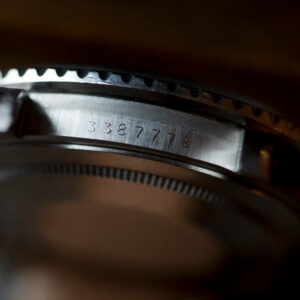
The inner case back of the 7922 Big Crown (Image: RPR)

1958 – Reference 7924 (Big Crown)
Following the success of the reworked 7922, Tudor introduced the 7924 in 1958, the first Submariner officially rated to 200m. Fitted with gilt dials marked 200s and Mercedes hands and like the previous experimental batch, it featured an 8mm Rolex winding crown.

A Tudor Submariner 7924 (Image: Tudor Collector/Luca Garbati)

1959 – Reference 7928 (Crown Guard Case)
By 1959, Tudor introduced the 7928, marking a major design shift with the addition of crown guards. This model evolved through four variations of crown guards: Square, Eagle Beak, Pointed, and Rounded crown guards. Alongside these case modifications, the 7928 initially featured a gilt black 200m dial, Mercedes hands, and a 7mm Rolex winding crown. This model remained in production for over a decade and the dials transitioned from glossy to matte in the mid to late 1960s.

A first series ‘Square Guard’ Tudor Submariner 7928 (Image: Tudor Watch)

A ‘Pointed Crown Guard’ Tudor Submariner 7928 (Image: Tudor Watch)

1974 – Reference 7016 (First Snowflake MN Watches)
The arrival of the 7016 in 1974 signalled a new era for Marine Nationale Tudors. This was the first reference to feature the now-iconic Snowflake hands, developed in direct response to requests for improved underwater legibility. The early 7016s were fitted with black dials and black bezel inserts, paired with square marker dials. These watches retained the 7mm Rolex winding crown. Crucially, this was also the first reference to feature the hallmark MN case back engravings, with issued examples engraved MN74. Watches from this batch generally fall within the 827xxx serial range.

The first black Snowflake Submariner 7016 (Image: Tudor Watch)

1975 – Reference 9401 (Blue Snowflake MN Watches)
In 1975, Tudor introduced the reference 9401, which became the definitive Marine Nationale Tudor for many collectors. These watches featured blue dials with matching blue bezel inserts, Snowflake hands, and the same square marker dial layout as the earlier 7016. The 7mm Rolex winding crown remained unchanged. These watches were issued through the early 1980s and continued the MN case back engraving tradition.

The iconic blue Snowflake Submariner 9401 issued to the MN (Image: Tudor Watch)

Early 1980s – Reference 9401 (Blue Mercedes or lollipop hands MN Watches)
By the early 1980s, the last generation of Marine Nationale Tudors transitioned to a new dial configuration. These late 9401s featured blue dials and bezel inserts but reverted to Mercedes pattern hands, paired with a triangle marker dial layout. The 7mm Rolex winding crown remained a consistent feature. These were among the last Tudors officially issued to the Marine Nationale before the official relationship came to an end.

Last series 9401 with lollipop hands and triangle quarters (Image: Fratello)

Key Features of MN-Issued Watches
Determining whether a Tudor Submariner was officially issued to the Marine Nationale can be challenging. Unlike many military-issued timepieces that came with standardised documentation, Marine Nationale Tudors were tools of the trade, utilitarian watches issued directly to Navy divers and commandos with little regard for future collectability.

The full ledger book from Toulon, listing all the MN watches serviced (Image: RPR)


An example of a page from the ledger (redacted serials). For example, line 206 shows a Tudor with serial 912xxx issued to Commando Hubert (Image: Watch My Watch)

One of the most important sources for verifying an MN-issued Tudor comes from a Rolex watchmaker based in Toulon, who meticulously recorded every Marine Nationale Tudor that passed through his workshop for servicing. However, it is crucial to note that these records only account for watches issued to the southern base in Toulon. There are no surviving records for watches issued in northern France, making verification for those examples much more difficult.

For models issued before 1974, the only definitive way to confirm an MN-issued watch is if it appears in the Toulon watchmaker’s ledgers. Watches from this period lack military engravings, meaning provenance and historical documentation are essential.

A Submariner 9401 issued in 1975 – note the long form date that was only used in 1975 (Image: Tudor Collector)

A Submariner 9401 issued in 1978 (Image: Christoper Beccan)

From 1974 to 1982, Marine Nationale Tudors featured distinct case back engravings, making them far easier to identify. These engravings followed a standardised format with the letters MN followed by the year of issue. The placement of the engraving varied slightly over the years:

  • 1974 – MN 74 – Centre of case back
  • 1975 – MN 1975 – Centre of case back (the only year with the full year engraved)
  • 1976 – MN 76 – Centre of case back
  • 1977 – MN 77 – Centre of case back
  • 1978 – MN 78 – Bottom of case back
  • 1979 to 1982 – MN 79, MN 80, MN 81 and MN 82 – Centre of case back

While these engravings provide strong evidence of Marine Nationale provenance, collectors should always be mindful of originality. Over the decades, some watches have had their engravings polished off or case backs swapped during service. As always with military watches, careful research and authentication remain key.

The Modern Evolution: The Pelagos FXD

In May 2021, Tudor reaffirmed its historical connection with the Marine Nationale, announcing an official partnership with the French Navy. While the brand had long celebrated its military heritage, most notably with the Black Bay Fifty-Eight, the launch of the Pelagos FXD marked a significant return to true military collaboration. Unlike previous releases that paid homage to the past, the FXD was designed specifically for modern Marine Nationale divers, tailored to the operational needs of Commando Hubert, the elite combat swimmer unit of the French Navy.

The standard production civilian Pelagos FXD with four-line dial (Image: Tudor Watch)

Whilst the FXD is very much a watch designed with the Marine Nationale, the actual watches delivered to the Commando Hubert divers differ from those sold by official Tudor retailers. The most obvious difference is the dial. Devoid of any mention of chronometer certification, the issued watches display a stripped-back aesthetic, featuring only PELAGOS and 200m, not even the imperial 600ft depth rating. This no-nonsense approach to the dial design reinforces the FXD’s role as a purpose-built military tool.

The case back is also significantly different. One of the most distinctive elements of the retail FXD is the engraved MN case back, a direct nod to the hallmark case back engravings found on vintage Marine Nationale Tudors from the 1970s and 1980s. These historical engravings consisted of MN followed by a short-form year, such as MN74 for 1974 or MN76 for 1976. (A small but interesting detail—only in 1975 did Tudor engrave the full year, marking watches as MN 1975.) The retail FXDs continue this tradition, with watches produced in 2021 engraved MN21, followed by MN22 in 2022, and so on. However, the actual issued watches used by Commando Hubert divers feature a much more stripped-back case back, engraved with only the year and a small issue number, reinforcing their utilitarian nature.

Finally, the reference number of the issued watches is ‘25797’ where the civilian reference is ‘25707’.

A Command Hubert delivered Pelagos FXD. Note the two-line dial. (Image: Monaco Legend Group)

The FXD retains the core characteristics that made Marine Nationale Tudors iconic: a robust, functional design, lightweight materials, and fixed strap bars for added durability. With its 42mm titanium case, ultra-legible dial, and bi-directional countdown bezel—specifically designed for underwater navigation—it is a modern-day MilSub, not just a marketing exercise. It embodies Tudor’s historical relationship with the Marine Nationale while proving that the collaboration remains as functional today as it was in the 1950s.

For collectors and enthusiasts, Marine Nationale Tudors remain among the most desirable tool watches on the market. Whether it’s the patinated charm of an original “M.N.”-engraved 7016 or the cutting-edge engineering of the Pelagos FXD, these watches embody the perfect balance of heritage, functionality, and military precision.

A Command Hubert delivered Pelagos FXD with accessories (Image: Monaco Legend Group)

By Ross Povey for Daniel Bourn. 

Ross Povey is a journalist, editor and founder of tudorcollector.com. He is internationally recognised as the leading authority on vintage Tudor watches and a key figure in the Tudor collecting community.

© Copyright Daniel Bourn www.danielbourn.com

If you would like to discuss, learn, or SELL your vintage military-issued Rolex, Tudor, Omega, or Blancpain timepiece, please don’t hesitate to contact us:

info@danielbourn.com
+44 7977 469 568
@daniel.bourn

Receive the latest watch content – straight to your inbox. SUBSCRIBE here

The Rolex ‘Military’ Submariner

In 1972, the Rolex Submariner replaced the Omega Seamaster as the watch of choice for the UK military, as specified by the Ministry of Defence (MoD). Military-specification Rolex Submariners (often referred to as MilSubs by collectors) were delivered to the MoD by the Rolex Watch Company and issued to both the UK Special Forces (UKSF), Special Boat Service (SBS) and Special Air Service (SAS) divers.

The features of the military Rolex Submariner differed from those of the standard production Submariner sold through authorised retail outlets, as the military versions were modified to meet the specific requirements of the MoD’s elite units.

Approximately 1,200 modified, military-specification Rolex Submariners were delivered by Rolex to the Royal Navy and British Army between 1972 and 1979.

Due to their use in challenging environments, the survival rate of MilSubs in their original configuration is low. This rarity, combined with their fascinating and important military provenance, is the reason they have become so sought after by vintage and military watch collectors.


A full-spec MilSub reference 5513 (Image: The Collections Vol I)

The Model References

The original Rolex military Submariners were issued using three different references 5513, 5513/5517 (referred to as a double reference) and 5517. Each reference is engraved as follows:-

  • 5513                (engraved between the lugs at 12:00)
  • 5513/5517     (5513 engraved between the lugs at 12:00, and 5517 engraved below the 7:00 lug)
  • 5517                (engraved between the lugs at 12:00)

Note: Whereas model reference 5513 was a modified version of the existing standard-production Rolex Submariner, model reference 5517 was unique to the military Submariner. This particular reference was never sold commercially and has therefore become the most sought-after of the three references among collectors.


The 5517 engraving on the lug of a double reference 5513/5517 (Image: The Collections Vol I)

Full Specification

Each reference of the Rolex Military Submariner shared the same modified specifications:

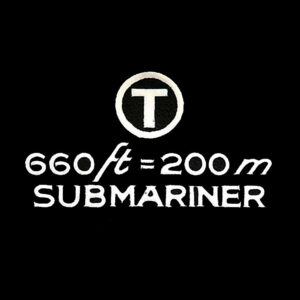
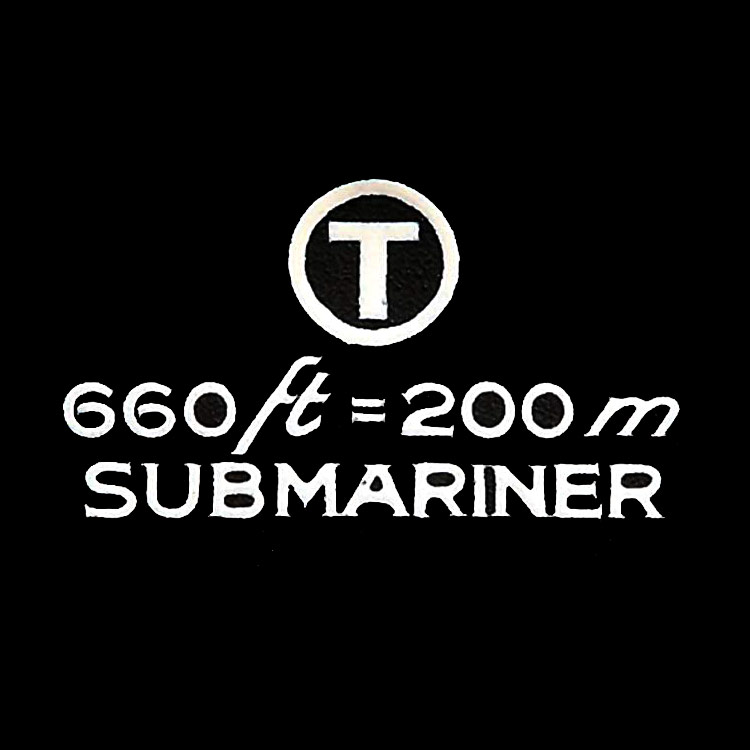
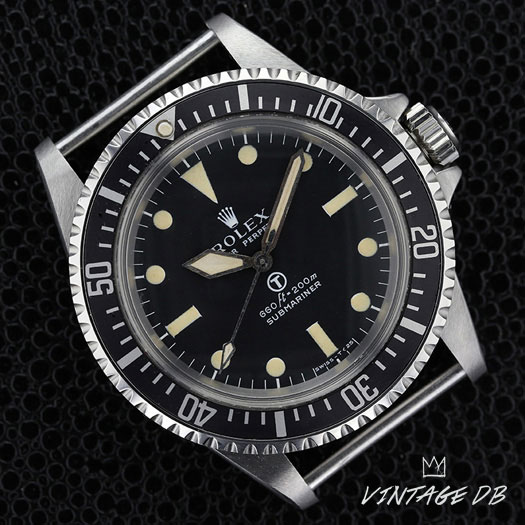
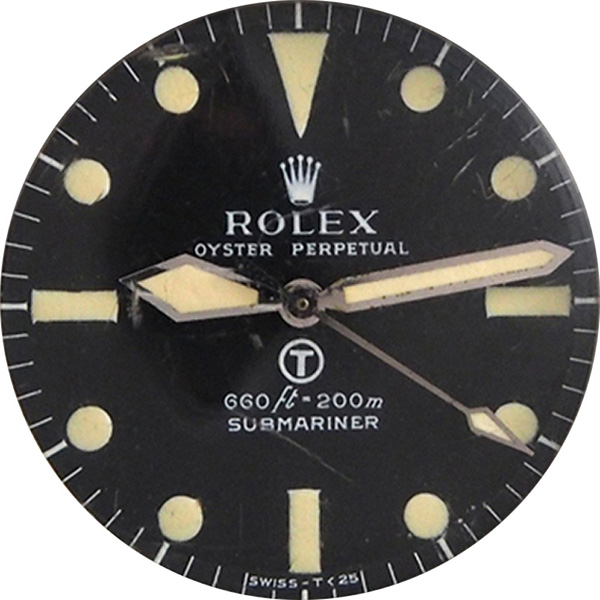
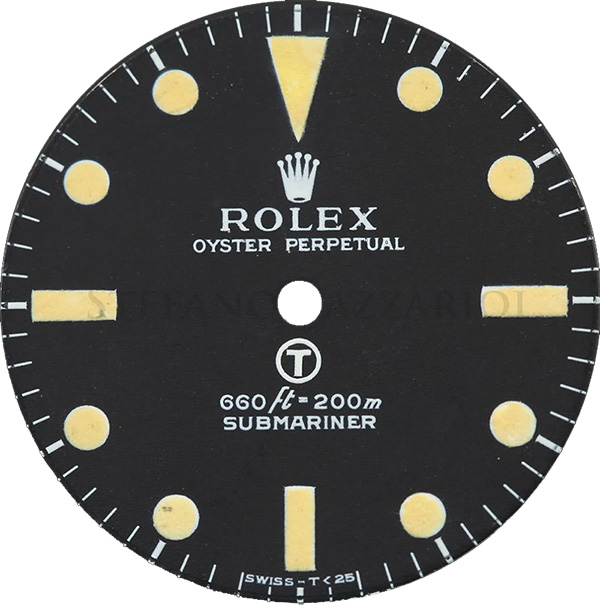
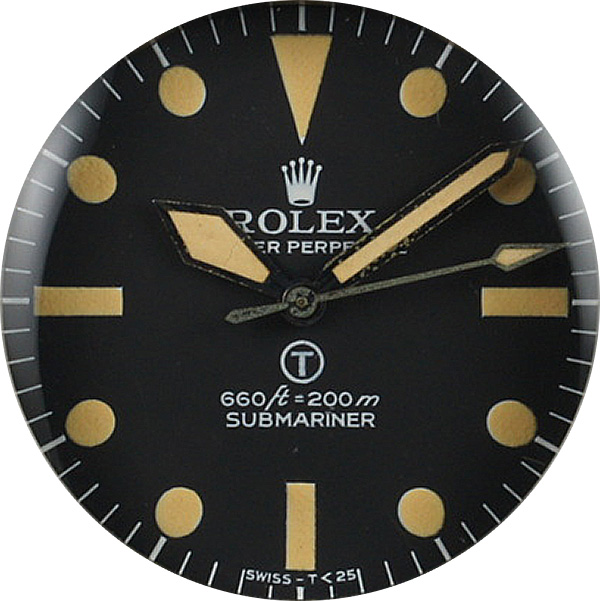
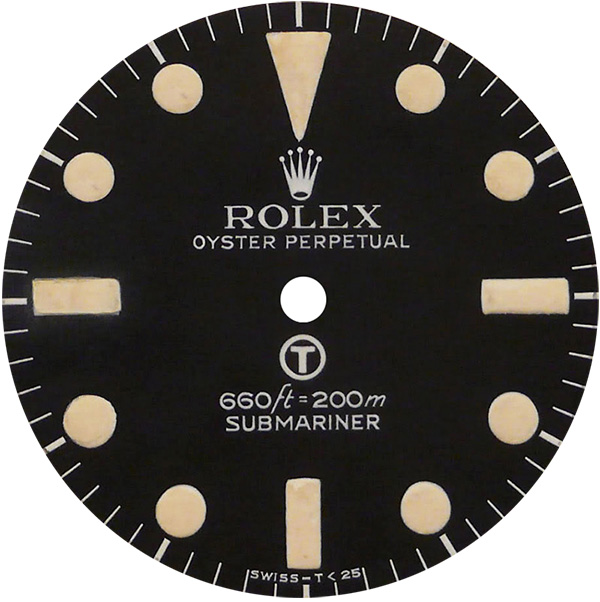
  • A 600 ft = 200 m matte dial with a circled ‘T’, denoting the use of tritium in the luminous compound
  • Sword or ‘gladiator’ hands for greater visibility
  • A continuously graduated 60-minute bezel insert for more accurate time measurement underwater
  • An anti-reflective satin case finish
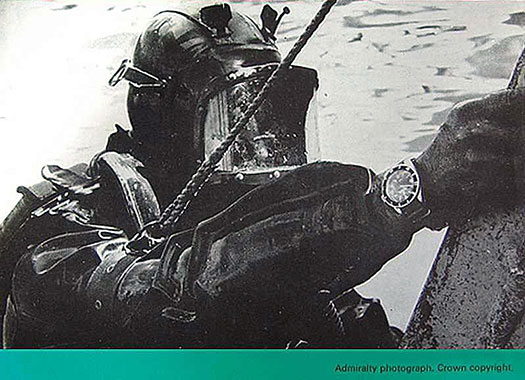
  • Military fixed bars for enhanced durability, designed for use with an Admiralty strap
  • Military, crown property, and unique issue case-back engravings

As mentioned above, due to the harsh conditions they were often exposed to, MilSubs required servicing more frequently than their standard civilian counterparts. Unfortunately, this has resulted in far fewer watches surviving in their original configuration. Watches that remain in original condition, with the full military specification as defined above, therefore continue to attract significant premiums.


The MoD-specified continuously graduated 60-minute bezel insert (Image: The Collections Vol I)

The Dials

The dials of the issued Rolex military Submariner were standard Submariner dials, modified with a circled ‘T’ placed below the hands and above the SUBMARINER model designation.

Between 1972 and 1979, four dial variations were used, as follows:

Serif

Non Serif

Smudge Crown

Maxi Mk 1

The different dial types were not exclusive to any particular model reference but were relevant to the date of issue of the watch. For example, a serif dial should typically be found on certain batches of model reference 5513 until 1977, and on the final batch of 3.9 million double references (5513/5517) issued in 1979. The non-serif dial is most often found on watches with serial numbers in the 3.7 and 3.8 million range. The so-called smudge or pre-Comex dials are generally found on watches issued circa 1976/77. The maxi dial appears on watches issued from 1977 onwards.

It should be noted that variations on the above exist, as dials may have been swapped or replaced during servicing, especially by MoD watchmakers.


A full-spec MilSub reference 5517 with maxi dial (Image: The Collections Vol I)

Outer Case Backs

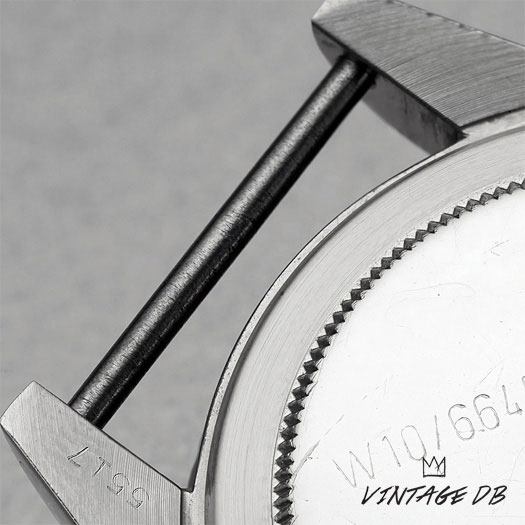
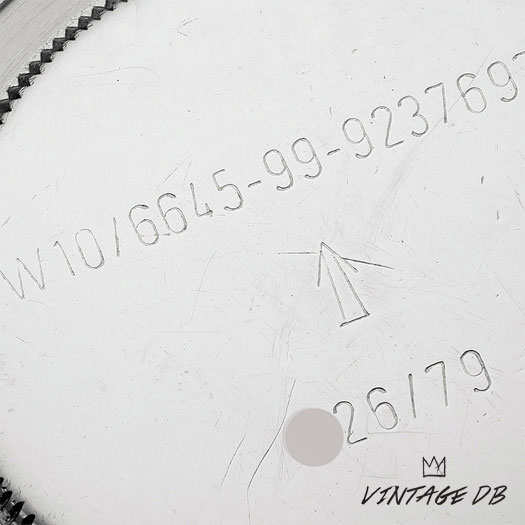
The outer case back on a correct, full-specification Rolex MilSub was engraved according to whether it was a British Navy (0552) or British Army (W10) issue.

Contrary to popular belief, all watches would have been used for diving. Although the W10 deliveries were Army or SAS issue, during the 1970s, both units trained as divers, and the watches were therefore available to divers from either branch.

Royal Navy (0552 issue):

  • 0552 (RN MOD service code)
  • 923-7697 (NATO code for divers’ watches)
  • Broad Arrow
  • Issue number / Year of issue

British Army (W10 issue):

  • W10 (MOD code for the Army)
  • 6645 (NATO code for time-measuring instruments)
  • 99 (NATO code for the UK)
  • 923-7697 (NATO code for divers’ watches)
  • Broad Arrow
  • Issue number / Year of issue


An Army-issued case back (Image: The Collections Vol I)

Inner Case Backs

The inner case back on a correct Rolex MilSub will include the following engravings:

  • Model ref. ‘5513’
  • Date of case/case back manufacture
  • Serial number matching the case (depending on the particular batch. Some known batches did not have the case serial number engraved in the case back)

Important: MilSubs sometimes surface with mismatching serials in the case back, meaning that at some point the case back of one MilSub was incorrectly fitted to the case of another during service by MoD or independent watchmaker. Whilst the mistake is easy to understand, it has a significant impact on the value and desirability of the watch.

Documentation

The original 1970s military Rolex Submariner deliveries to the MoD, for issue to the UKSF, were not supplied with the typical box and papers that accompanied standard Submariners sold through retailers. However, later documentation can accompany these watches, which are of particular interest to collectors. This documentation generally takes the form of:

  • Documented provenance from the original owner, such as details of service, photographs, and dive logs. It must be noted, however, that due to the covert nature of their occupations, many original owners prefer to remain anonymous, making such documentation difficult to acquire.
  • A Rolex delivery confirmation letter signed by the former General Manager of Rolex UK, Henry Hudson.

In the 1970s, Mr. Hudson’s department was responsible for delivering the military-specification Submariner to the UK military. Although he later assumed the role of General Manager of Rolex UK, he continued to retain the original delivery records for each issued watch (including serial number, case-back number, and unit or dockyard). Until his retirement in 2011, he would often kindly provide this information, where available, to owners of a MilSub via a signed letter on Rolex-headed paper.


A pair of full-spec MilSubs with original Admiralty straps and Henry Hudson letter (Image: The Collections Vol I)

Unfortunately, since his retirement, this service is no longer available. Rolex no longer confirms the original delivery information. While watches accompanied by the “HH papers,” as they are commonly referred to, do not carry a significant financial premium, collectors value the reassurance regarding the original issue that such documentation provides.

Perfectly correct and collectible examples continue to surface on the market without papers. This does not mean they should not be acquired and enjoyed. We recommend consulting one of a handful of known specialists (ourselves included) who have been collating model reference, serial, case-back, and delivery information for many years. Such experts can provide reassurance regarding the batch to which your watch belongs and any specific nuances you should expect to find.

© Copyright  Daniel Bourn www.danielbourn.com

If you would like to discuss, learn, or SELL your vintage military-issued Rolex, Tudor, Omega, or Blancpain timepiece, please don’t hesitate to contact us:

info@danielbourn.com
+44 7977 469 568
@daniel.bourn

Receive the latest watch content – straight to your inbox. SUBSCRIBE here

Milsub advert

A Guide to Dating your Rolex Watch

ROLEX SERIAL NUMBERS AND DATE OF MANUFACTURE

Understand Rolex serial numbers and how they relate to production years. Identify the manufacture date of your vintage or pre-owned Rolex.

How old is your Rolex watch ?

The serial number on any Rolex watch enables you to estimate the approximate date of manufacture. On the majority Rolex watches the serial number is engraved between the case lugs at 6:00 just behind the bracelet end links. However on some earlier models (pre 1960) the serial number will be engraved on the outer case back. This four to eight digit number can be used to determine the date of manufacture. It is important to note however that final assembly, sale and delivery of the completed watch may be some time later. For example a case or case back assembled in 1967, may not have been used on a completed watch until 1970 or sold via a retailer until later still.

From 2005, Rolex started to also engrave the serial number on the inside case rehaut which is found between the dial and the crystal.

From 2008, Rolex started to only engrave the numbers on the rehaut.

From 2011, Rolex started to use a random numbering system, hence in years to go dating your Rolex watch will need to be established by either referring to the original warranty card, understanding the configuration of your particular example or referring directly to Rolex.

SERIAL NUMBER LOOKUP

To identify the date of your Rolex watch manufacture, refer to the following table. The serial ranges listed will provide an indication regarding the date of manufacture. Please note the serial number range Rolex used restarted again circa 1953. Care should therefore be taken when dating watches with serials which could fall into both the pre and post 1953 date ranges provided.

Rolex Serial #Year of Manufacture
990001940
1060001941
1435001942
2305001943
2695001944
3020001945
3650001946
5290001947
6280001948
7090001951
7265001952
8555001953
230001954
970001955
1330001956
2240001957
3280001958
3995001959
5160001960
6430001961
7440001962
8240001963
10090001964
11000001965
12000001966
15380001967
17520001968
19000001969
22410001970
25890001971
28905001972
32005001973
35680001974
38620001975
41150001976
50080001977
50000001978
57370001979
64340001980
65200001981
71000001982
74000001983
80700001984
86140001985
89000001986
R0000011987
94000001987
R5982001988
L9800001989
E0000011990
N0000011991
X0000011991
C0000011992
S0000011993
S8605001994
W0000011995
T0000011996
U0000011997
U9320001998
A0000011999
K0000012000
P0000012000
K or Y2001
Y2002
F2003
F2004
F2005
D2005
D or Z2006
M or Z2007
M or V2008
V2009
G2010
Random2011 onwards

CONTACT US

Should you have any further questions relating to the age of your vintage or pre-owned Rolex watch or if you require further information on the watch with a view to service, trade, consign or sell. Please do not hesitate to contact us via email at info@danielbourn.com

Receive the latest watch content – straight to your inbox. SUBSCRIBE here

The Rolex ‘Oman’ SeaDweller

The state of Oman occupies the south-eastern extremity of the Arabian Peninsula, a location of considerable strategic significance owing to its proximity to, and partial control over, the maritime routes through which a substantial proportion of the world’s oil supply transits the Gulf. The country has maintained longstanding military and political relationships with the United Kingdom and the United States.

Since 1744, Oman has been governed by the Al Bu Sa‘id dynasty. Historically, it functioned as a prominent regional power, with a sultanate extending into parts of present-day Iran and Pakistan, and reaching southward to Zanzibar on the coast of south-eastern Africa. Over subsequent centuries, however, Oman’s regional influence diminished, and the state became increasingly subject to British political and strategic interests.

Between 1932 and 1970, Oman was ruled by Sultan Sa‘id bin Taimur.

Sultan Sa’id bin Taimur ,1910-1972 (Image: Wikidata)

Sultan Sa‘id bin Taimur, while careful to preserve Oman’s longstanding relationship with the United Kingdom, demonstrated little interest in the sustained stability or modernization of his country. His deliberate isolation of Oman from external influence, resistance to social and economic development, and inability to manage the increasingly complex dynamics of domestic politics ultimately elevated Omani internal affairs to an international concern.

By the early 1960s, discontent in the province of Dhofar had coalesced into an organized rebellion that would adopt Marxist ideology and evolve into the Popular Front for the Liberation of Oman. The insurgency intensified as the decade progressed. In 1966, Sultan Sa‘id survived an assassination attempt, that further heightened his reclusiveness and erratic governance. His growing suspicion and authoritarianism spared no one, including his own son, Qaboos bin Sa‘id.

Sultan Qaboos and the Coup d’état

Sultan Qaboos bin Sa‘id (pictured below) was born in Salalah, Dhofar, on 18 November 1940. In 1960, at the age of 20, he entered the Royal Military Academy, Sandhurst, in England, where he formed a close friendship with Tim Landon, who would later become a significant ally in the development of Oman. After graduating from Sandhurst, Qaboos joined the British Army and was posted to the 1st Battalion, the Cameronians (Scottish Rifles), serving in Germany.
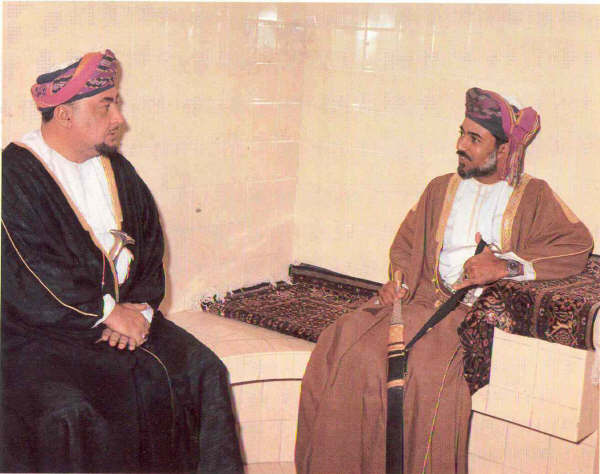
Sultan Qaboos Bin Sa‘id circa 1960 (Image: Keystone)

On his return to Oman in 1964, Qaboos was placed under house arrest by his father, Sultan Sa‘id, and remained there until 23 July 1970. With the support of the British government, who had become increasingly concerned by Sultan Sa‘id’s behavior and, with Oman on the brink of an oil boom, were eager to secure their influence, operatives from the SAS were deployed to assist Qaboos, together with his friend Tim Landon, in deposing his father in a palace coup d’état.

Brigadier Timothy “Tim” Landon, the mysterious “White Sultan,” as he became known, is believed to have been a key ally in the plot to overthrow the old Sultan and install his son on the throne. A latter-day T. E. Lawrence, Landon served Britain through his close bond with the Arab world. He remained a close friend and advisor to Qaboos throughout his life.

Brigadier Timothy ‘Tim’ Landon (Image: Dhofar War Image RJK Adonib via The Times)

The above image is one of only a few known to exist of Landon, a man who guarded his privacy with extreme care. It is said that when at home in the UK, he would drive a privately owned black London taxi to avoid attention. Sultan Qaboos is believed to have sent Landon a gift of £1 million each year on his birthday, contributing to the significant estate Landon left upon his death in 2007.

Following the coup, the deposed Sultan Sa‘id bin Taimur went into exile in London, where he died two years later. When once asked about his greatest regret, the former Sultan is reported to have replied: “Not having Landon shot.”

The New Oman and the SAS

On his ascension to the throne in 1970, Qaboos instigated major social, educational, and military reforms, with the aim of ending the country’s isolation and using its oil revenue for modernization and development.

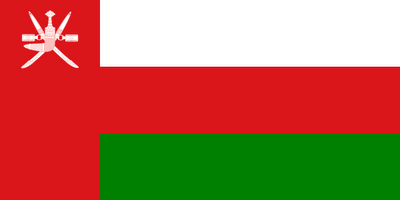
As part of a wider rebranding exercise, he declared that the country would no longer be known as Muscat and Oman, but would instead be called the Sultanate of Oman to reflect its political unity. This was complemented by a new national flag, replacing the plain white flag that had been in use since 1865. The national flag of Oman, in use from 1970 to 1995, featured three colours: red, white and green.

The national flag of Oman

The colours of the new flag symbolised the following:

  • White – peace and prosperity
  • Green – fertility and the Jebel al Akhdar, or Green Mountains
  • Red – battles against foreign invaders

The flag also incorporated the national emblem: a Khanjar dagger in a sheath, superimposed upon two crossed swords.


The Oman national emblem, a Khanjar dagger in a sheath superimposed upon two crossed swords.

Qaboos also added a new individual standard for the Sultanate of Oman, which exclusively featured the Khanjar in Gold with Sultans Crown above.
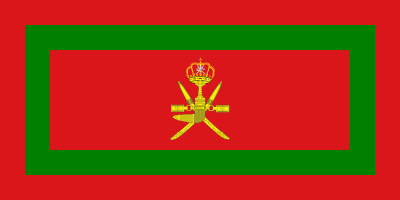
The standard for the Sultanate of Oman

In addition to implementing the necessary reforms to safeguard Oman’s future, Qaboos faced another issue: the Dhofar Rebellion, which had commenced in 1962, was by 1970 growing ever stronger.

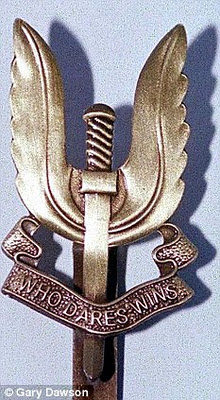
British military commanders in Oman suggested that a “hearts and minds” campaign, code-named Operation Storm, be implemented, primarily by operatives from the British Special Forces’ elite 22nd SAS Regiment (Boat, Air, Mobility & Mountain counter-terrorism specialists).

Once Operation Storm was underway, many of the Omanis who opposed the Dhofar rebels (because of differing beliefs) sided with the SAS, who formed them into “counter gangs” using their superior local knowledge—a strategy that had worked well for the SAS in both Kenya and Malaya. The SAS gradually began to occupy commanding positions along the mountain range throughout the Dhofar region, engaging in running battles with the rebels as they did.

Nine SAS versus 250 Dhofar Rebels

The Battle of Mirbat took place at 6 a.m. on 19 July 1972. It has become one of the most famous standoffs in the regiment’s history; many have compared it to the renowned battle at Rorke’s Drift.

A nine-man permanent SAS team had been established at Mirbat earlier in the year. Each team was due to be posted for a three month tour before being replaced. The occupying team was preparing to leave that very morning when, at about 5:30 a.m., a patrol discovered 250 rebels on a hill to the north of the town.

One of the SAS gunners recalled what happened: “We opened fire simultaneously, unleashing a hail of .50-cal bullets and machine-gun fire at the approaching Adoo rebels. The running figures became a focal point where the red tracer and exploding incendiary rounds converged. Where moments before there had been an orderly advance, parts of the line now faltered and collapsed. Figures staggered, but still they kept coming, wave upon wave over the plain.”

The surrounded SAS troops knew the situation was serious; a frontal assault could only mean they were facing a very large force. A message was sent to SAS HQ at Salalah. The rebels were well organised, advancing in groups and using the high ground to lay down covering fire. By now, rounds were coming in from all directions over the forts.

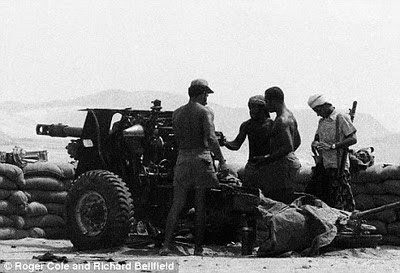
A lull in the fighting, as the rebels recovered their wounded, allowed two SAS troops to reach the gun pit of an antique 25-pounder (pictured below), which was used to devastating effect on the rebels. As they fell, more replaced them.

A gun pit during the Battle of Mirbat (Image: lordashcroft.com)

The perimeter walls started to collapse under heavy grenade attacks. A helicopter sent by HQ attempted to land on the nearby beach to evacuate the wounded but was hit by enemy machine-gun fire and forced to turn back. At the gun pit, one of the SAS troops had been killed, and the other, with a bad wound to his chin, resorted to firing the gun single handedly, with the cannon raised to fire level at point-blank range.

The 23-year-old SAS captain, Mike Kealy, radioed for an air strike. By now, the rebels were almost on top of the gun pit. The remaining men continued to pick off the advancing troops despite an almost continuous hail of bullets and grenades. Just as all seemed lost, two Strike Master jets roared overhead.

From the radio, the jets were given targets. They would have to drop 500 lb bombs on positions less than 60 yards from the gun crew. Just the sight of the jets had an immediate effect on the rebels, many of whom began retreating. One jet was hit by heavy machine-gun fire and forced to withdraw; more aircraft were called in while the rebels continued to retreat. A squadron based at SAS HQ was also dispatched and landed on the beach after flying in very low to avoid detection. A second air strike began as they were landing.

By 10:30 a.m., the rebels were forced to retreat in numbers. The wounded were loaded onto helicopters and flown back to HQ.

SAS casualties included two dead and two seriously wounded.

In Britain, the battle received no publicity, and the gallantry awards were not awarded until some four years after the event. The nine SAS soldiers present at the Battle of Mirbat on 19 July 1972 were:

  • Captain Mike Kealy
  • Staff Sergeant Talaiasi Labalaba (Killed in Action) (memorial pictured below)
  • Sergeant Bob Bennett
  • Corporal Roger Cole
  • Lance Corporal P. Warne (aka Pete Wignall or Winner, Soldier I & Snapper)
  • Trooper Sekonaia Takavesi (Killed in Action)
  • Trooper Tommy Tobin
  • Austin “Fuzz” Hussey
  • Corporal L. M. Taylor (understood to have been an alias)

Staff Sergeant Talaiasi Labalaba Memorial (Image: Viti Noqu Viti FB)

Mission Accomplished

When the Dhofar rebellion finally ended in 1976, with the insurgents suppressed, the SAS contingent that had been engaged in the conflict from the time of the coup amounted to around 80 men (supported by Oman locals). The insurgents had numbered almost 15,000, a staggering achievement.

The 22nd SAS Regiment went on to engage in countless other anti terrorist campaigns, and achieved notoriety during the 1982 Iranian Embassy siege which was broadcast worldwide.

Recognition by Gifts

In the Gulf, it is customary to present gift, often watches, in recognition of achievements, appreciation, or as a mark of respect. British troops on active duty were not normally allowed to accept such gifts. However, in the case of Oman circa 1970–76, these restrictions did not apply. The SAS were never officially on active duty, but operated in Oman under the cover of the “British Army Training Team,” as per official documentation at the time.

Two examples, which we have previously owned and subsequently placed in important collections, provide the perfect opportunity to study further both the Rolex 1665 Red and Gold Khanjar Sea-Dwellers, which were presented as gifts to SAS operatives by Qaboos for the 1970–76 Oman campaign.

The Rolex Red Oman Khanjar and Qaboos Sea-Dwellers

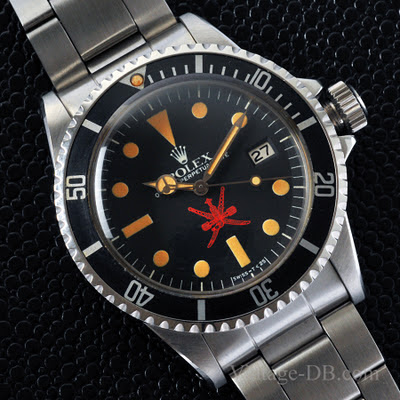
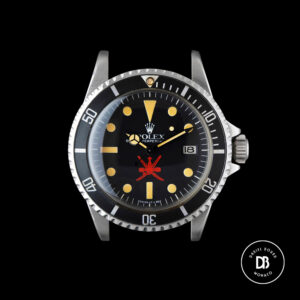
The Rolex reference 1665 Oman Sea-Dwellers, with either red Khanjar or Qaboos dial script, were commissioned by Sultan Qaboos bin Sa‘id via Asprey of London in the early 1970s and presented to British SAS troops who had served in Oman during the Dhofar Rebellion between 1970 and 1976.

A Rolex Sea-Dweller reference 1665 with red Khanjar emblem (Image: The Collections Vol I)

Many of the watches that have surfaced, like the one above, are found with a deep patina, caused by Middle Eastern humidity being absorbed by the tritium markers.

A Rolex Sea-Dweller reference 1665 with red Qaboos signature (Image: The Collections Vol I)

The configuration of the watches that have surfaced to date is as follows:

  • The double red lines, depth rating, and SCOC found on standard 1665s of the period are absent. In their place, the Omani Khanjar or Qaboos signature appears in bright red script.
  • The tritium on the five-minute markers is applied very heavily.
  • The serial numbers all begin 3.56 million and are engraved between the lugs at 6:00 and inside the inner case back.
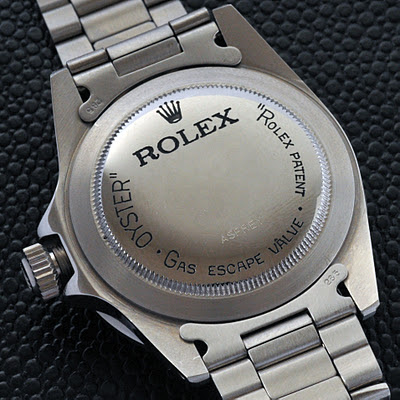
  • The outer case back features the expected straight “Rolex”-style engravings of the period, along with Asprey engravings positioned in the lower centre.

A Rolex Sea-Dweller reference 1665 with Asprey case back (Image: The Collections Vol I)

Following a comprehensive study of the known serial numbers, I believe up to 100 examples were produced in a consecutively numbered batch, starting with serial 3.566.9xx and ending at 3.567.0xx. Of these estimated 100 examples, approximately 30 percent are now known. The known watches are evenly split between red Khanjar and Qaboos dials, and the two variants appear to have been fitted in a random sequence, for example, consecutive serials may feature either dial, followed by small batches of three to four with the same type.

A Rolex Sea-Dweller reference 1665 side profile (Image: The Collections Vol I)

The estimated number of watches issued could be supported by the number of SAS soldiers who served in Oman during the period 1970–1976, again reported to be around 80 to 100 operatives, so the assumption that each soldier would have been allocated an Oman Sea-Dweller in recognition of their services has some foundation.

A Rolex Sea-Dweller reference 1665 with red Qaboos signature helium valve detail (Image: The Collections Vol I)

The use of the colour red for the Khanjar or Qaboos signature on the dials is also relevant to the colour of the new Oman national flag during this period. Red appropriately symbolises battles against foreign invaders.

The Rolex Gold Oman Khanjar Sea-Dweller

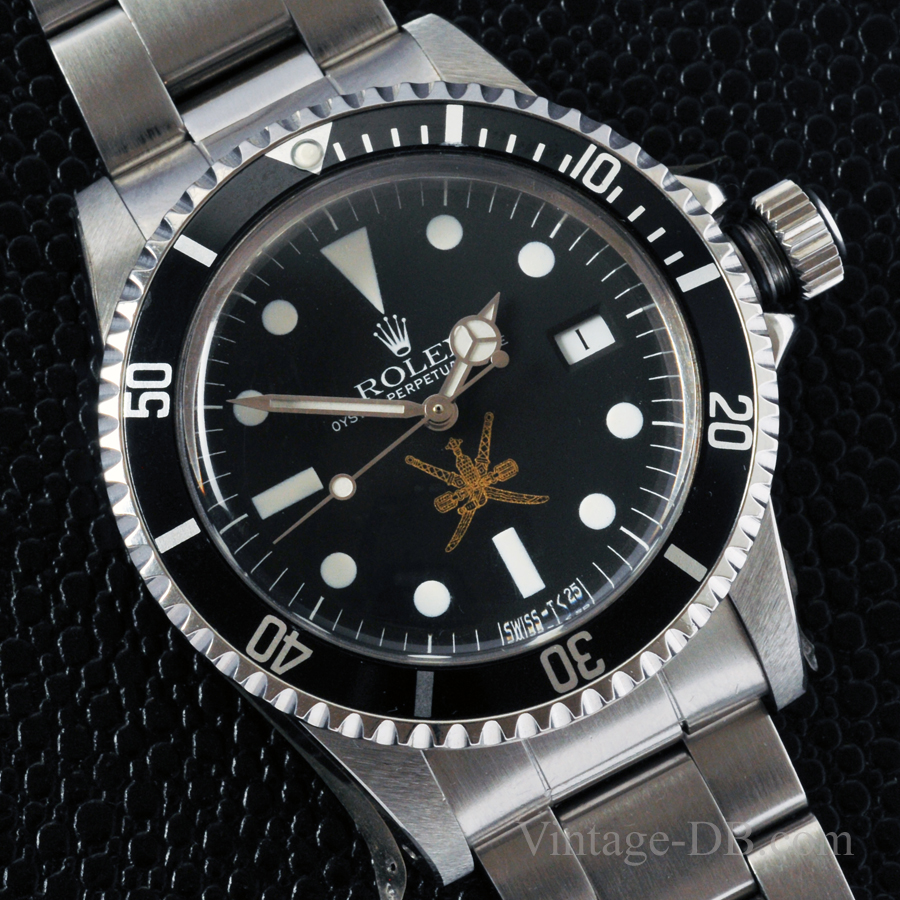
A Rolex Sea-Dweller reference 1665 with gold Khanjar emblem (Image: The Collections Vol I)

To date, only five examples of the Rolex 1665 Omani Sea-Dweller with gold Khanjar dial script have surfaced, and as such, the information on configuration and delivery is something of a mystery when compared to its red counterparts. The watch featured above is the fourth example to surface, with each new discovery aiding our understanding of the batch.

The configuration of the Rolex 1665 Omani Sea-Dwellers with gold Khanjar dials that have surfaced to date is as follows:

  • The two lines of Double Red Text, depth rating, and SCOC found on the standard 1665s of the period are absent, and in place the Omani Khanjar appears in gold script.
  • The Rolex coronet on the dial is of a unique style and differs from the Rolex 1665 Oman Red Khanjar or other coronets on the Double Reds of the period.
  • The tritium application on the five-minute markers is absent or minimally applied.
  • The serial numbers all begin 5 million.

On further analysis of the known watches, the serials indicate something more. On four of the five known watches, the serials fall within the standard Double Red batch of 5 million.

I have deliberately omitted the serial numbers, but they indicate a consistent timeline.

On these four watches, the serial number is also engraved between the lugs at 6:00 and inside the case back.

Two of the above five watches have been serviced within recent years by Rolex Geneva, and records appear correct.

The remaining known example has a slight variation to the serial, and while close, is slightly later at 5.3 million. The case back style also differs, although consistent with the Great White Sea-Dwellers of this period. The inner case back does not have the serial number engraved inside, which, whilst again consistent with a 5.3 million serial Sea-Dweller, would also indicate that the dial was quite probably not born with the watch but fitted later, as it appears out of batch. However, until more examples surface or the delivery is confirmed by Rolex, it remains only speculation.

So how many of the Rolex 1665 Omani Sea-Dwellers with gold Khanjar dials were produced, and why?

If we assume the same ratio as with the Red Oman watches, approximately 100 watches produced, with 30 percent having surfaced to date, this would indicate a production of gold Khanjar Sea-Dwellers numbering up to around 15 examples.

Using the historical information provided earlier of Oman during the period 1970–1976, we know that the gold Khanjar was used only to represent the Sultanate of Oman on the Sultanate’s official standard, whereas the national flag features the Khanjar in white. If the use of red on the Red Khanjar/Qaboos Sea-Dwellers is, as we believe, significant, it would suggest the use of gold here would also be, possibly to indicate a special presentation directly by Sultan Qaboos himself.

We know that the Battle of Mirbat was under-reported, and many considered the SAS team deserving of further individual awards for gallantry. However, many in Oman at that time perceived a desire by HM Government and the MoD to downplay incidents of direct involvement of British service personnel in military action. The British Military Intelligence Corporal who received a medal for gallantry from the Sultan at the time was threatened with disciplinary action by the British Army for being directly involved.

So it was not until some four years later, after the battle and once the Dhofar Rebellion had been suppressed, that:

  • Captain Mike Kealy received the Distinguished Service Order.
  • Sergeant Bob Bennett was awarded the Military Medal.

The gunners manning the 25-pounder:

  • Trooper Sekonaia Takavesi received the Distinguished Conduct Medal, and
  • Staff Sergeant Talaiasi Labalaba was awarded a posthumous Mention in Dispatches.

His former comrades have since campaigned for him to receive a posthumous Victoria Cross.

We know that Qaboos was fully aware of the Battle of Mirbat, as he presented an Omani named Walid Khamis, who was injured during the battle, with the Sultan’s Gallantry Medal, Oman’s highest award.

Given that the Battle of Mirbat was a pivotal moment in defeating the insurgents, and the lack of recognition given to the SAS soldiers by their own government, it is not inconceivable to think that Qaboos, who had previously commissioned the Red Oman watches to commemorate the SAS soldiers who occupied Oman during the 1970–1976 campaign, would commission a small, special batch to honour the nine SAS soldiers (and possibly others like William Stoker, SOAF Strike Master jet commander) who put their lives at risk during the Battle of Mirbat to defend Oman from the rebellion. Of course, without official delivery information from Rolex, Qaboos, or the surviving SAS soldiers, this is just speculation, but should encourage further discussion, research, and understanding of the events in Oman during the 1970s and the important watches that commemorate the period.

© Copyright  Daniel Bourn www.danielbourn.com

 If you would like to discuss, learn, or SELL your vintage Oman delivered Rolex timepiece, please don’t hesitate to contact us:

info@danielbourn.com
+41 79 515 1922
@daniel.bourn

Receive the latest watch content – straight to your inbox. SUBSCRIBE here